
Medically reviewed by Mr Rob Laycock, Consultant Maxillofacial and Cosmetic Surgeon, GMC 6145445. Last reviewed October 2026.
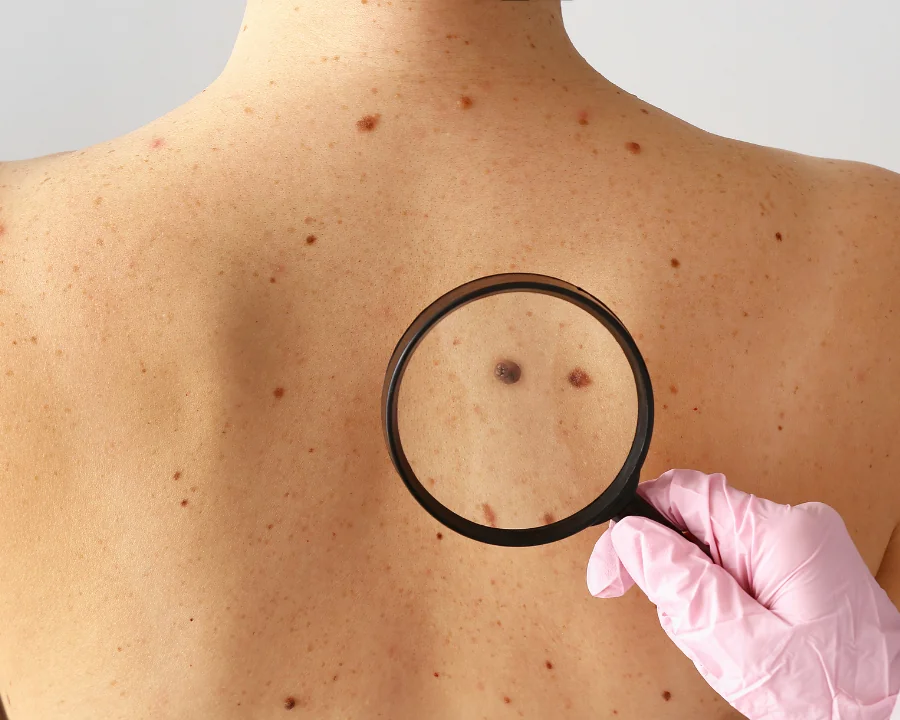
Get a mole checked promptly if it changes in size, shape or colour, or if it starts to bleed, itch or crust. A new mole, especially after the age of 30, should also be seen. Otherwise, check your own moles once a month. A yearly professional check is usually advised for people at higher risk.
How Do You Know If A Mole Needs To Be Checked?
A mole needs to be checked if it is new, changing or causing symptoms. If you are unsure, that is reason enough to ask. See your GP or a dermatologist promptly if you notice any of the following.
- A new mole, especially after the age of 30.
- A mole that is changing in size, shape or colour.
- A mole that bleeds, itches, crusts or becomes raised.
- A spot or sore that does not heal within 4 weeks.
- A dark streak under a nail that is not due to an injury.
These signs matter because of melanoma, a type of skin cancer that can spread to other parts of the body. Most melanomas are curable when they are found early, which is why a change is worth acting on quickly. The NHS gives similar advice on when to see a GP about a mole.
What Are The Five Warning Signs Of Melanoma?
The five warning signs are known as the ABCDE guide. Each letter describes a feature that makes a mole worth showing to a clinician.
- A for asymmetry. The two halves of the mole look different.
- B for border. The edge is irregular, ragged or blurred.
- C for colour. There are several colours or shades, or the colour is uneven.
- D for diameter. The mole is larger than about 6 mm, roughly the width of a pencil, or growing.
- E for evolving. There is any change in size, shape, colour or height, or new itching, bleeding or crusting.
Look for the odd one out as well. A mole or mark that looks different from all your others, sometimes called the ugly duckling, should be checked even if it does not match the list above.
How Often Should You Check Your Own Moles?
Once a month. That is the interval our dermatologists recommend.
Check your skin in good light, using a full-length mirror and a hand mirror. Ask someone to help with your back and scalp, which are the hardest places to see. Include the places that are easy to miss: the soles of your feet, between your toes and under your nails. The aim is to get to know what is normal for your skin, so that anything new or different stands out.
Photographs help. Taking a picture of a mole with a ruler beside it gives you a record of its size, which makes a change much easier to judge a few months later.
How Often Should A Professional Check Your Moles?
That depends on your risk, because there is no set schedule for everyone. There is no national skin cancer screening programme in the UK, so nobody is routinely invited to have their moles checked.
If you are at higher risk, our dermatologists usually advise a skin check once a year, adjusted to your own risk. They may ask to see a particular mole sooner than that, to confirm it is stable.
If you are not at higher risk, there is no fixed interval. Keep up your monthly checks, and get a mole checked as soon as you find a change.
Who Should Have Their Moles Checked Regularly?
People at higher risk of skin cancer have the most reason to have their moles checked regularly by a professional. You are likely to benefit if any of these apply to you.
- You have many moles (more than 50), or moles that are large or unusual.
- You have had melanoma or another skin cancer before.
- A parent, brother or sister has had melanoma.
- You have fair skin that burns easily, red or blonde hair, or a history of severe sunburn or sunbed use.
- You have a weakened immune system, for example after an organ transplant.
- You find your moles hard to keep track of, or want reassurance.
If you recognise yourself in this list, it is worth asking a dermatologist how often you should be seen.
Who Can Check Your Moles?
You have two routes to get a mole checked. You can ask your GP, who can examine a mole free of charge and refer you to a specialist if there is any concern. Or you can see a dermatologist privately, without a referral.
A private check suits people who want a specialist to examine their whole skin, or who want their moles monitored over time. At The Pinewoods Clinic, checks are carried out by consultant dermatologists who also hold NHS consultant posts, and mole mapping is led by Dr Tiberiu Bontea. You can book a consultation about a single mole, a full body mole check, or mole mapping, which photographs your skin so that changes can be tracked from one visit to the next.
If a check finds something that needs treatment, the clinic also treats skin cancers and carries out mole removal. You can read more about mole checks and mole mapping in Liverpool, or contact us to book.
Does A Clear Check Mean You Can Stop Checking?
No. A professional check, including mole mapping, is not a guarantee that a skin cancer will not develop, and a melanoma can occasionally grow quickly between visits.
Professional checks work best alongside monthly self-checks and good sun protection. If a mole changes between appointments, report it without waiting for your next one.
Frequently Asked Questions
Is A Raised Mole A Cause For Concern?
A mole that becomes raised when it was flat before should be checked. What matters is the change, so any mole that alters in height, size, shape or colour is worth showing to a clinician.
Can Photos Or An App Replace A Professional Check?
No. Photographs are useful for spotting change over time, and you can show them to your doctor. They do not replace an examination by a clinician.
What Happens If A Check Finds Something?
Your dermatologist may recommend removing the mole, or taking a sample, so that it can be examined in the laboratory. That is how a diagnosis is confirmed, so being advised to have a mole removed is not in itself a diagnosis.
How Can You Protect Your Skin Between Checks?
Use a broad-spectrum sunscreen of SPF 30 or higher on exposed skin every day in spring and summer. Seek shade between 11am and 3pm, cover up with clothing, a hat and sunglasses, and never use sunbeds.